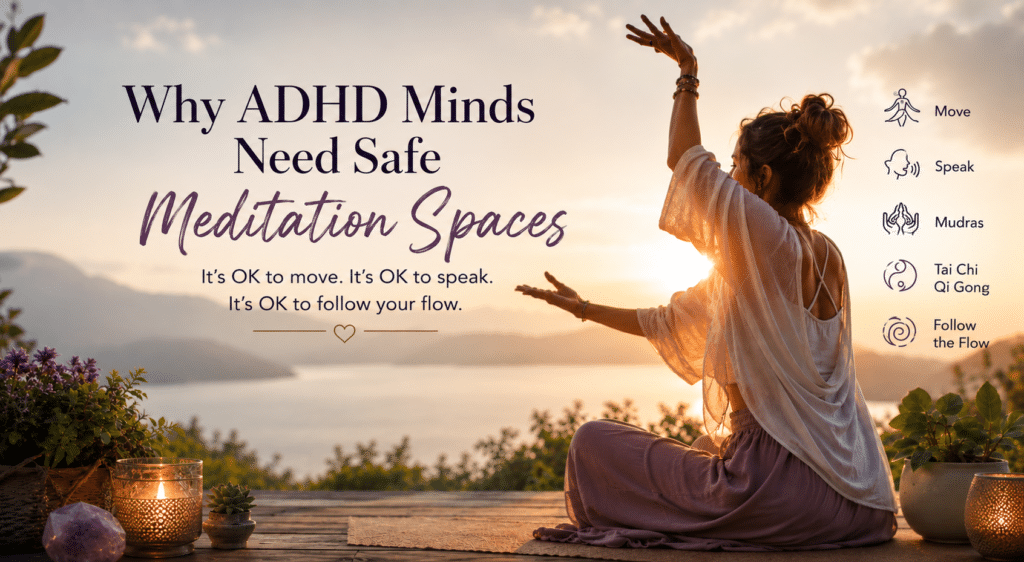
And Why Meditation Doesn’t Have to Be Still.
For many people with ADHD, traditional meditation advice can feel frustrating.
“Sit still.”
“Clear your mind.”
“Don’t move.”
“Focus on your breath.”
While these techniques may work for some, many ADHD individuals discover that forcing themselves into rigid meditation practices creates tension rather than peace. The very qualities that make ADHD minds unique—creativity, movement, spontaneity, sensitivity, and energetic awareness—often need a different approach.
The ADHD Mind Is Not Broken
The ADHD mind is naturally dynamic.
Thoughts move quickly. Energy flows in waves. Inspiration appears unexpectedly. The body often wants to move, stretch, gesture, or express itself. When meditation is presented as a process of suppressing these natural tendencies, it can feel like another environment where a person is being asked to become someone else.
But meditation does not have to be static.
Meditation is not defined by stillness. Meditation is defined by presence.
The moment you become deeply present with your experience, you are entering a meditative state.
Movement Can Be Meditation
Many ADHD individuals discover that they access deeper states of awareness when movement is included.
This might mean:
- Gentle body movement
- Tai Chi
- Qi Gong
- Walking meditation
- Spontaneous stretching
- Flow-based movement
- Hand gestures and mudras
- Conscious breathing while moving
Rather than fighting the body’s natural impulses, movement becomes a doorway into presence.
The body is no longer a distraction from meditation—it becomes part of the meditation.
Sound Can Be Meditation
Some people enter deep states of stillness through silence.
Others enter through expression.
Light language, chanting, humming, toning, singing, or simply allowing spontaneous sounds to emerge can help quiet mental noise and create a sense of energetic alignment.
For certain ADHD minds, speaking or vocalizing during meditation creates more focus than trying to remain completely silent.
Meditation is not about following a universal formula.
It is about discovering the pathways that allow your awareness to settle naturally.
Following the Flow
Many meditation traditions teach structure.
There is value in structure.
But there is also value in flow.
Some days your meditation may involve sitting quietly.
Other days it may involve movement, breathing, mudras, energy work, contemplation, journaling, or simply following an inner impulse that feels authentic and present.
The goal is not perfection.
The goal is connection.
When ADHD individuals are given permission to follow a natural flow rather than force themselves into a rigid process, meditation often becomes more accessible, enjoyable, and sustainable.
The Importance of a Safe Space
Perhaps the most important ingredient for meditation is not technique.
It is safety.
Many people with ADHD have spent years being told they are too much, too distracted, too sensitive, too energetic, too emotional, or too unconventional.
As a result, they often carry an unconscious expectation that they will be judged when they express themselves authentically.
Meditation becomes far more powerful when practiced in an environment where nothing needs to be fixed.
A safe space allows the nervous system to relax.
A relaxed nervous system allows awareness to deepen.
And deeper awareness creates the conditions for genuine transformation.
The Silent Gateway: A Safe Space for Authentic Expression
At The Silent Gateway with Patrice Krysztofiak, the focus is not on forcing people into a predefined spiritual mold.
Instead, the space encourages authenticity.
People are invited to show up exactly as they are.
- To move if they need to move.
- To speak if they need to speak.
- To use mudras, light language, breathing practices, energy work, Tai Chi, Qi Gong, or simply sit quietly.
- There is no requirement to fit into a specific meditation style.
For many ADHD individuals, this creates something rare: a genuinely safe container where their natural way of being is welcomed rather than corrected.
When judgment disappears, self-expression expands.
When self-expression expands, inner awareness becomes easier to access.
And when awareness deepens, meditation stops feeling like a struggle and begins feeling like coming home.
Meditation is not about becoming someone else.
It is not about suppressing movement, thoughts, creativity, or energy.
For many ADHD minds, meditation works best when it honors the way the mind and body naturally function.
Whether through movement, mudras, light language, Tai Chi, Qi Gong, breathwork, or stillness, the path is less important than the presence it creates.
The most powerful meditation space is often the one where you feel safe enough to be yourself.
And from that place of safety, awareness can unfold naturally.